Your Career Isn't a Ladder. It's a Video Game You Don't Know You're Playing
The official walkthrough for ditching the default quest and designing your own character.

Intro: You Probably Didn’t Mean to Start Playing This
Let’s talk about something weird.
You’re playing a video game right now.
It’s called Your Life™. And whether you realize it or not, you’re deep into the main questline: Career Mode.
Wait… What Kind of Game Are We Playing?
If you’ve ever played a Role-Playing Game (RPG) — think Zelda, Skyrim, or even The Witcher — you know the drill.
You start as a weak, confused character. You choose a class (like wizard, warrior, or rogue). You complete quests. You level up. You unlock skills. You fight increasingly bizarre bosses. You collect weird loot (like an Amulet of Slightly Better Public Speaking™).
You also make decisions that shape your story. Sometimes you grind. Sometimes you explore. Sometimes you accidentally trigger a side quest that spirals into a whole new career.
Most importantly: there’s no one “right” way to play. And no one gives you a proper tutorial.
Real life? Suspiciously similar.
So even if you’ve never touched a PlayStation controller or built a Dungeons & Dragons character sheet, don’t worry — I’ll walk you through the metaphor as we go.
🧠 Tl,dr; You’re the main character. Your career is the quest. This essay is the unofficial walkthrough you never got.
—
Now, the awkward part is:
Most of us didn’t choose to play this game.
We kind of... spawned into it.
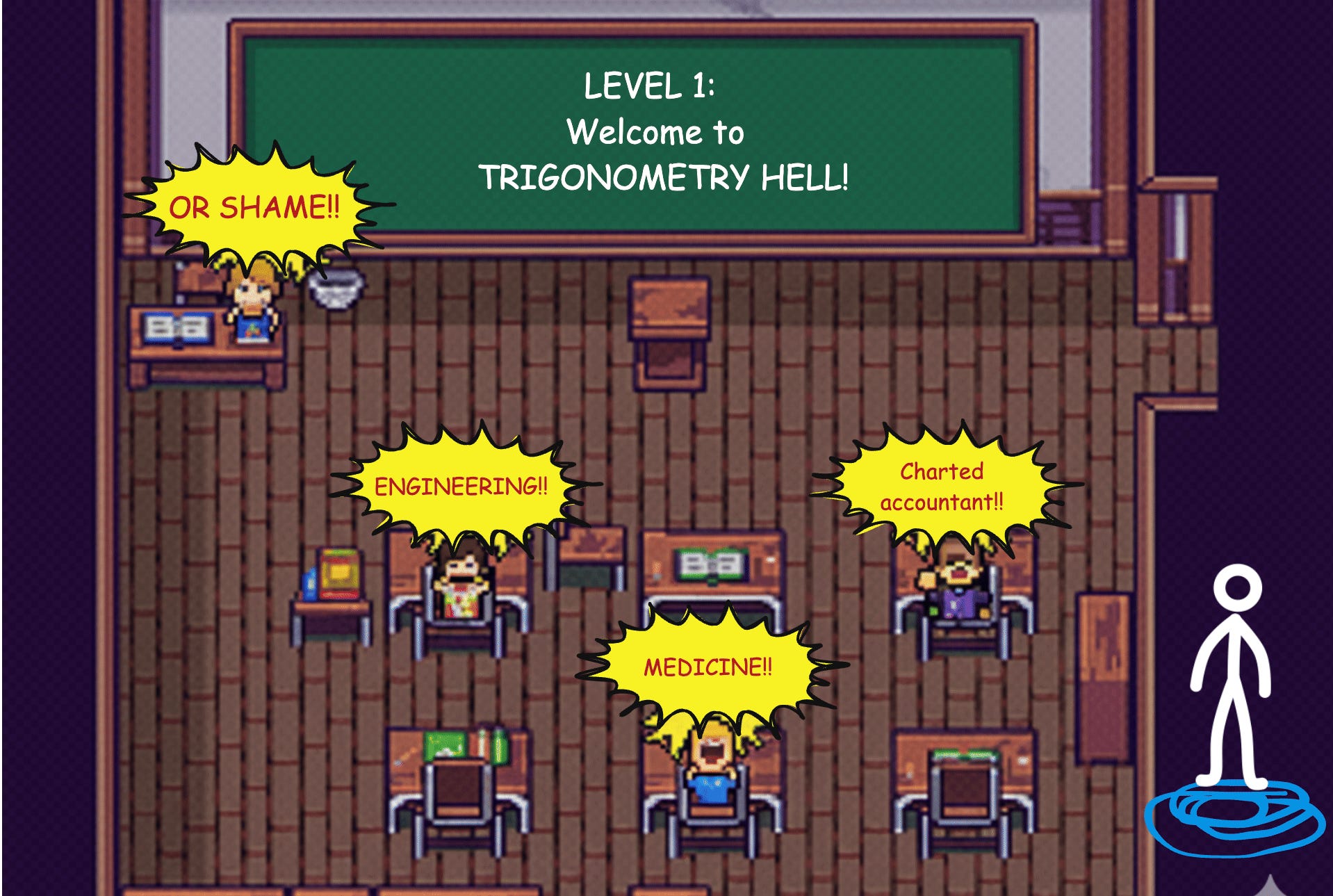
When you were around 16 or 17, you were handed a broken controller, a laggy user interface, and a bunch of vague instructions like:
“Pick a stream.”
“Get into a top college.”
“Don’t screw this up — this is your whole future.”
And the worst part?
No one told you what kind of game this was.
No tutorial. No manual. No ability to skip the cutscene where Uncle Raj explains why he regrets not doing an MBA.
So you picked something — maybe a safe bet, maybe what your marks allowed, maybe whatever felt least like failure — and the screen blinked:
🎯 MAIN QUEST ACTIVATED: Climb the Ladder
Objective: Study hard → Get job → Upgrade job → Get a spouse → Buy apartment → Buy bigger apartment → Retire or burn out
💀 Failure Condition: Not doing all this before age 35
The Problem
This game isn’t broken.
It’s just… auto-piloted by default.
And if you don’t bother reprogramming it, the system assigns you the generic questline most people are on — the “9-to-5 → promotion → 2 vacations per year → mysterious midlife crisis at level 42” route.
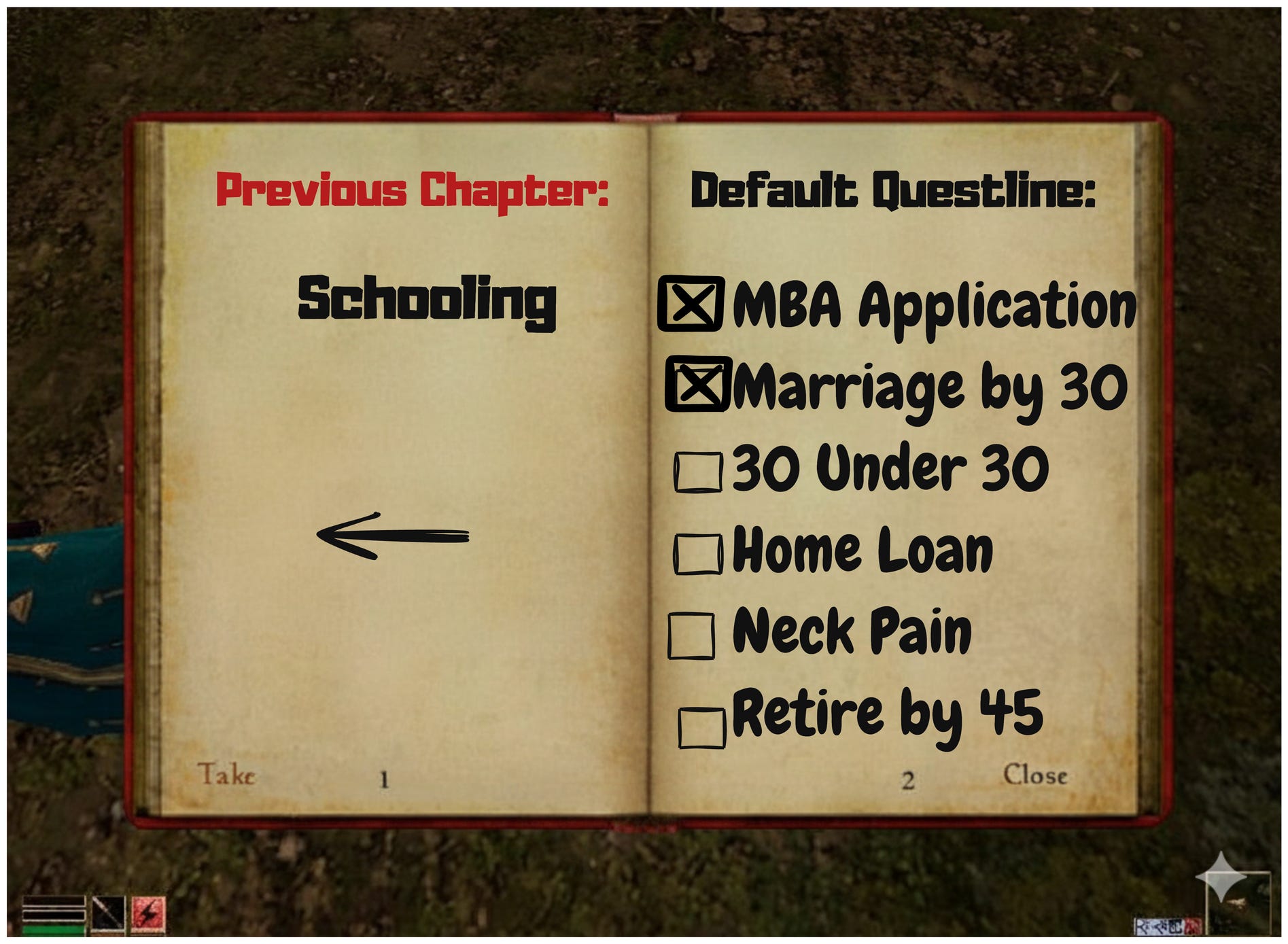
But here’s the thing.
Somewhere along the way — somewhere between meaningless calendar invites and corporate jargon like “bandwidth constraints” — you start to get this weird feeling:
Wait... who the hell designed this game?
And why am I playing it on nightmare mode with no healing potions?
Enter: The Career Anxiety Multiverse™
If you’re a millennial or Gen Z, you already know the anxiety I’m talking about.
You’ve probably had at least one of the following thoughts:
“Am I behind?”
“Should I switch industries?”
“Why does everyone on LinkedIn sound like they’re running for Prime Minister?”
“Why is that 25-year-old on Forbes 30 Under 30 while I’m still learning how tax works?”
“Why do all startup founders look either suspiciously hydrated or deeply sleep-deprived?”
If any of those hit a little too close to home… you’re not alone.
This article is public.
So if you have a friend, colleague, or sibling quietly spiraling about their career path —
🎁 do them a solid and share this post.
You never know what kind of side quest you might unlock for someone just by forwarding the map.
In the corporate world, we’re surrounded by the pressure to optimize.
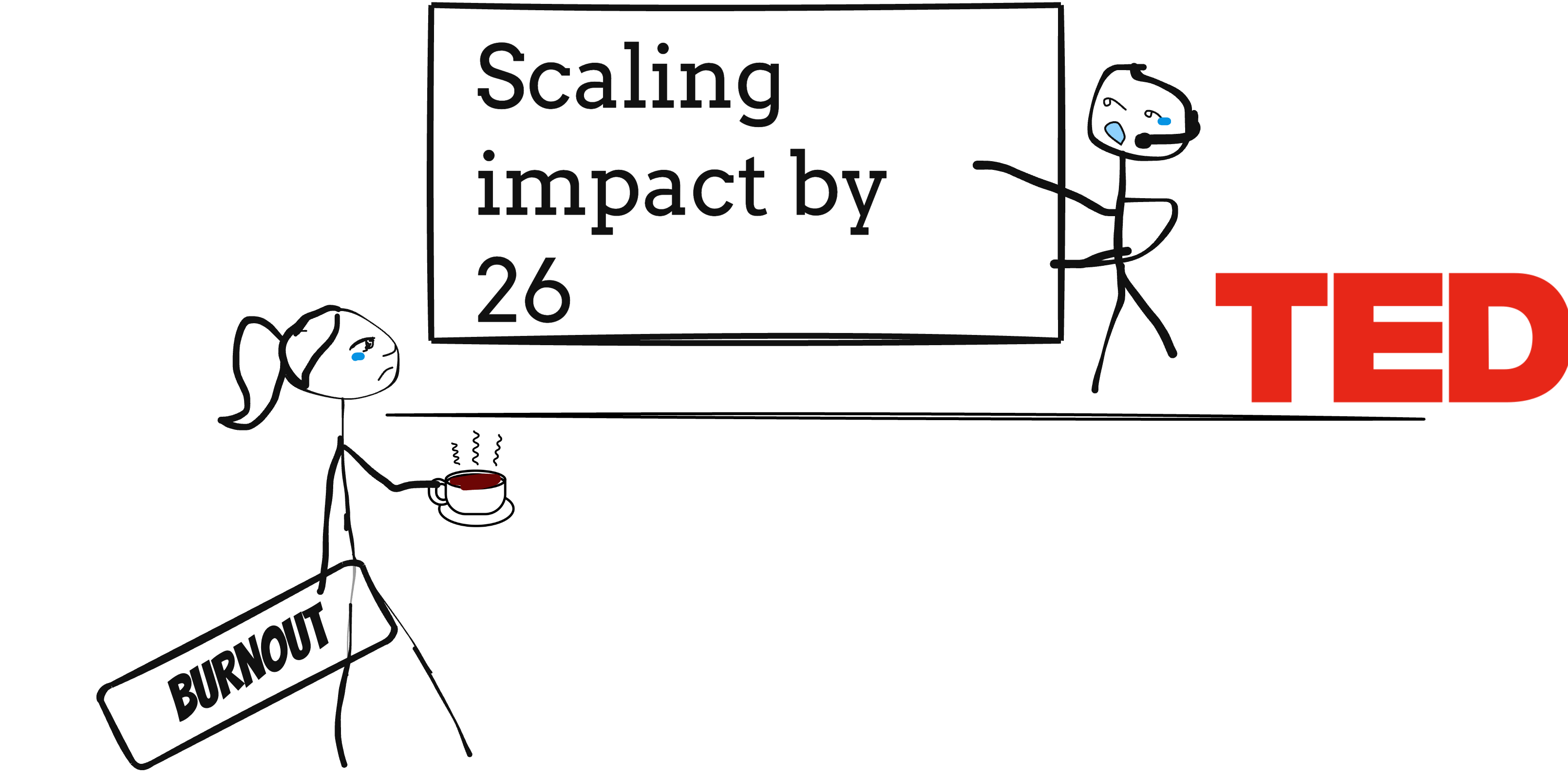
In the startup world, it’s even more cutthroat — where being the youngest, fastest, most-well-funded burnout victim is treated like a badge of honor.
Everyone’s speedrunning.
Everyone’s tweeting advice.
Everyone’s silently panicking while pretending they’re absolutely crushing it.
The Truth
No one really knows what they’re doing.
But some people are just better at designing the game they’re playing.
Because here’s the actual plot twist:
Life is a video game. And you can change the rules.
You can customize your build.
You can design your own win condition.
You can fight a different boss or leave the dungeon altogether.
This essay is your unofficial walkthrough.
A cheat-sheet for Career Mode.
A user guide no one gave you - not your school, not your boss, not your favorite productivity bro on YouTube. And no, it is not going to tell you to “follow your passion”.
It’s for people who:
Secretly feel like they picked the wrong class (Accountant) but really want to multiclass into Bard-Monk-Strategist
Want to take big bets, but worry they’re too late or too weird
Are tired of confusing job titles and want to find actual meaning
Want to stop pretending their LinkedIn banner is their soul
We’re going to talk about:
XP systems
Boss levels
Side quests
Skill trees
Regret monsters
And how to level up without rage-quitting at 29
By the end, I hope you’ll stop thinking of your career as a ladder to climb
…and start seeing it as a level to beat.
Ready?
Press START.
🧠 Level 1: The Tutorial (aka Your Early 20s)
Every game starts with a tutorial.
The problem is: in real life, the tutorial doesn’t come with a “Skip” button. Or a pop-up that says, “Relax, this is just practice.”
Instead, you get dumped into the opening level with:
A set of “base stats” you didn’t choose
Some blurry instructions from confused but well-meaning elders
And a parade of overly confident NPCs (parents, relatives, job interviewers, Instagram influencers) acting like they’ve already finished the game
And you’re expected to just... go.
It is unfair. It is random. But that’s just how it is.
But the good part is, you CAN boost XP and plump up your stats. You unlock side-quests, hidden quests, quests you can reach only after completing certain other quests - but that’s just how the world building has been done for this game.
✨ The Default Main Quest
The system does assign you a quest. We saw an example of it above — the Climb the Ladder questline.
This is the default main quest. You didn’t design it. You just spawned into it.
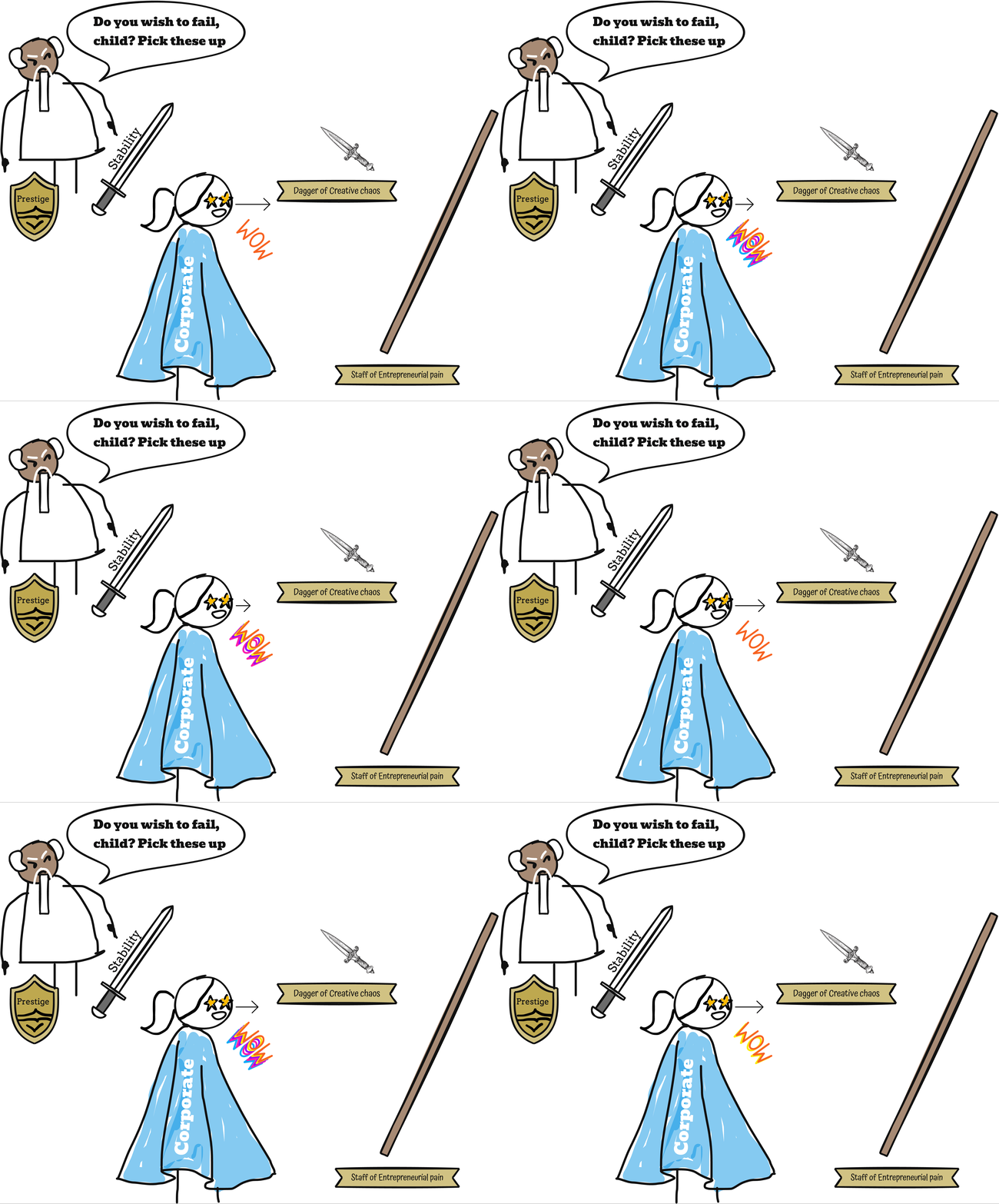
And the thing about tutorials? They try to funnel you toward a certain playstyle. You’re handed the Sword of Stability, the Shield of Prestige, and the Cape of Corporate.
When you try to pick up another weapon—say, the Dagger of Creative Chaos or the Staff of Entrepreneurial Pain—an NPC will appear and gently shame or scare you.
“Hmm... but how will this look on your CV?”
“Are you sure you can do that? Only 0.01% of the people make it.”
“You’re wasting your degree.”
It’s literally their job to give you FOMO. They’re quest-line enforcers.
🎓 My Tutorial Build: A Hot Mess (That Aged Like Wine)
Here’s what my tutorial looked like. On paper, it might look chaotic. But in retrospect, I was building a wildly versatile character. And this is the part nobody tells you about.
Here’s a short, selective summary written as —
Quest / Side Quest ———> Duration ———> What I Got / XP Gained
Chess obsession ———> 7 months ———> Went from “how does the knight move?” to State Gold Medalist, Under-13 National level player. Got confidence that I probably learn well in non-academic setups too.
Studied Pharmacy ———> 4 years ———> A functional understanding of the human body, food, cosmetics, drugs, did neuro-drug design research which today informs my “biohacking” lifestyle
Taekwondo, Karate ———> 3 months ———> Trained 3-4 hours a day for 3 months. Walked out with a gold medal, a cracked toe, and the knowledge that the human body can do wonders when pushed to its limits. 15 hour work days? What, like, it’s hard?
Sri Lanka Paper (final year) ——> 6 months ———> Presented research on challenges for women founders in startups; Got mistaken for the professor. Got drunk on academic validation, while spending sleepless nights planning to tackle the eventual glass - or as my study called it - “lucite” ceiling
Corporate projects during MBA———> 3-6 months each ———> Did social work field studies, practiced primary research techniques, digitized crime data for cops, helped the largest Self help group of women farmers go organic - all before turning 23
Coffee snobbery ———> Casual hobby ———> Made friends at my job in Dubai with the then-World Coffee champion; Learnt to argue about pour-over techniques with white men in suspenders. Also helpful around condescending Whiskey bros.
Theatre actor ———> ~16 years on and off ———> Context / character switching became a force of habit. I became my own mindset coach by “slipping into character” at high stakes situations in CEO’s office, Sales
Poker ———> 1 month (with a trainer) ———> Picked up just enough to take money from VC tables. Hehe. Hehehe.
This wasn’t strategy, and for sure not planned from the get-go. It was instinct + boredom + saying yes to things that seemed fun. It was only in hindsight that this XP combo started making sense.
I was trying weapons. I was leveling up agility. I was collecting weird XP from side quests no one else cared about.
🧠 What the Tutorial Teaches You (If You’re Paying Attention)
Tutorials aren’t meant for winning.
They’re for:
Learning how your character moves
Discovering your risk tolerance
Getting beaten up by the world and realizing you don’t die from embarrassment
Building your internal User Interface: what lights you up, what bores you to death, what you’re secretly good at
Most people try to optimize during the tutorial. Big mistake.
Trying to “look sorted” at Level 1 is like trying to min-max stats before you even know what game you’re playing.
📉 What Most People Think They Should Do
A lot of people follow advice that they pick up from places, including movies. Some particularly not-great ones are:
❌ “Find my passion” ——> You haven’t touched enough buttons yet to know what lights you up
❌ “Pick a stable job” ——> Stability early on can calcify you into a class you didn’t choose
❌ “Follow the youngest - X (founder/ player/ whatever) - ever” ——> Life is not a speedrun. And no one cares if you “sold your first company before 30” — unless you’re also…not miserable

The early game is not about clout. It’s about taste. Knowing what makes your brain sing before you sell it to the highest bidder.
What do you want to feel more of?
What friction are you weirdly willing to tolerate?
Where does your brain get noisy with ideas?
💪 Better Tutorial Strategy: XP Over ROI
✅ Say yes to weird projects.
❌ Don’t over think how it fits in your 5-year plan
✅ Build stamina, not status.
❌ Don’t get trapped by early prestige.
✅ Take note of what energizes you.
❌ Don’t mistake success for fulfillment.
✅ Track your own XP bar.
❌ Don’t look at someone else’s loot and panic.
You’re building a kit. You’re discovering your class. You’re preparing for boss fights you can’t even see yet.
✅ Level 1 Complete: You’re Now a Level 2 Human
You made it through the fog.
You didn’t win. But you didn’t quit.
You touched the buttons. You saw behind the curtain. You got a glimpse of what playing your own game might feel like.
And that, honestly, puts you ahead of 90% of players.
🍫 Level 2: Designing Your Own Quest (Before It’s Too Late)
If Level 1 was the realization that the default quest is a lie, Section 2 is what you do next: panic briefly, then pull up your imaginary quest journal and start scribbling.
Because here’s the thing — once you realize you can play your own game, you’d think the next step is obvious.
But it’s not. It’s terrifying.
You’ve exited the tutorial zone, sure. But now you’re standing in the forest in your underpants, holding a wooden spoon. There are paths in every direction and absolutely no NPC telling you what to do. Just a faint internal voice whispering, uh… maybe go that way?
And that’s the moment most people get stuck. So they… go back. To the main quest. The one they didn’t choose. Because at least it came with a job description and dental.
But not you. You, dear reader, you are stubbornly holding that spoon and deciding to figure this thing out.
🎯 The 3 Types of Main Quests (Choose Your Fighter)
Let’s break this down using a classic RPG archetype model:
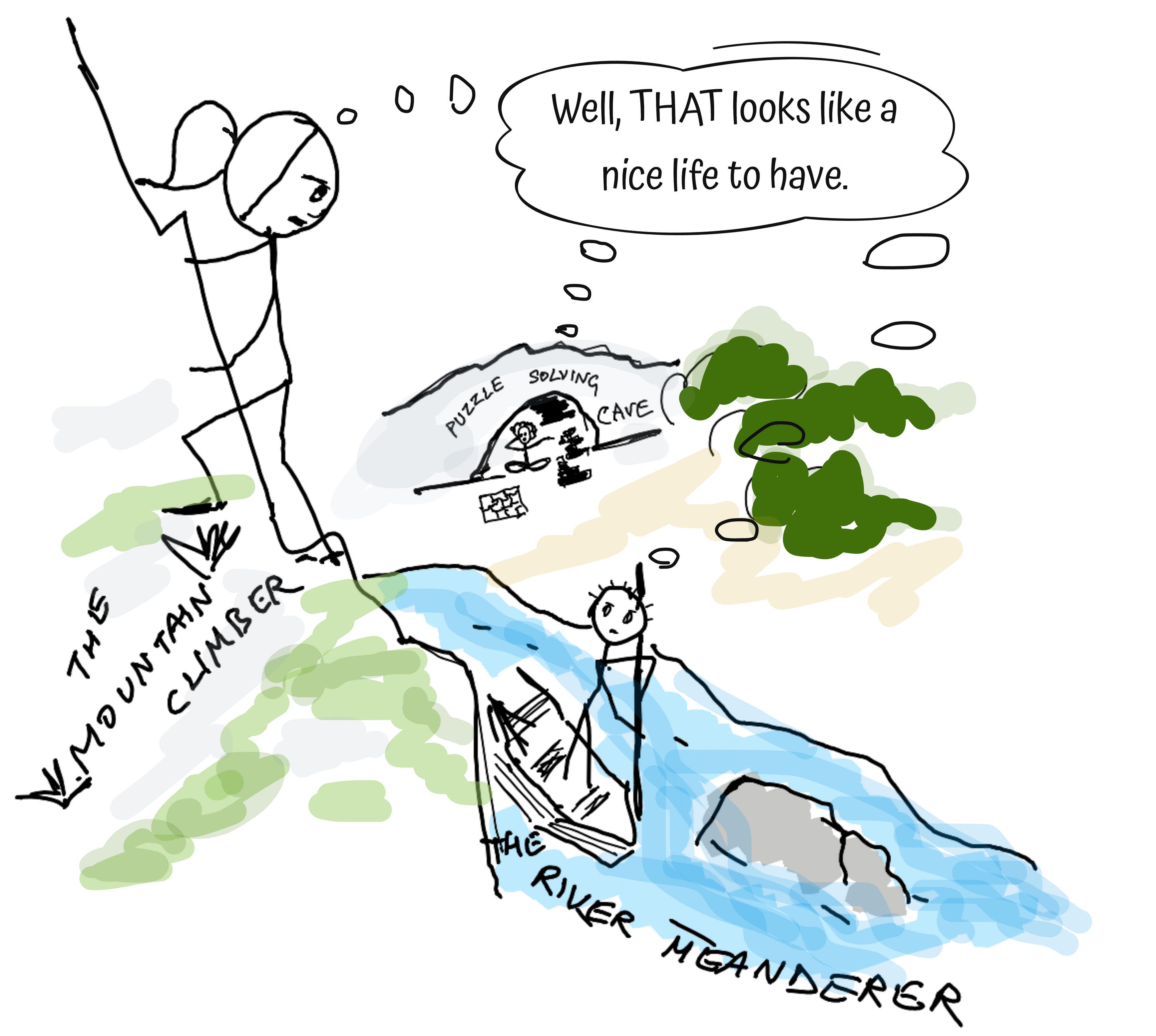
🏔️ Quest Type: The Mountain Climber
Description: Clear Destination. High ambition. Wants to be CEO, billionaire, or win a Nobel.
Danger level 🔴 : Burnout + Existential Crisis at Base Camp 3
🌊 Quest Type: The River Meanderer
Description: Wants richness of experience, not status. Flows around the rocks.
Danger level 🔴: May forget to build a savings account.
🧩 Quest Type: The Puzzle Solver
Description: Doesn’t care about the destination, just the next problem to solve. Often found starting companies or building odd things.
Danger level 🔴: Can become a hermit surrounded by half-built side projects.
Most people are a mix of the three. And that’s okay.
The trick is to consciously pick your primary quest type — and own it. Because if you don’t, you’ll end up measuring your life using someone else’s questline. (That’s how puzzle-solvers end up depressed on LinkedIn. Wrong scoreboard.)
While I didn’t formally sit down to write a life design manifesto in my early 20s, something instinctual kicked in. Every side quest I picked — chess, taekwondo, bike riding (oh yes, that too) theatre, MMA — was secretly running a simulation in the background. Testing my playstyle.
Turns out: I liked speed. I liked chaos. I liked building from scratch. And I liked beating the odds.
By the time I’d been through email-reads in bathtubs, chaotic 12-hour supply chain ops, and enterprise sales warfare, I realized I was playing what game designers would call a custom sandbox career.
There was no job title for it. No 5-year HR plan. But I felt alive.
⚔️ The Final Boss in this level: Guilt
The hardest part of designing your quest? Guilt.
Guilt that you’re not living up to your degrees. Guilt that you did not climb the mountain or meander with the river or solve enough problems.
Guilt that your parents can’t explain your job at weddings.
Guilt that you’re 31 and still don’t own property, unlike Tanya who just posted “#adulting” with a balcony view and an overpriced coffee machine.
And worst of all? The “youngest ever” cult.
🧠 “She became VP at 25.”
💰 “Forbes 30 Under 30.”
📉 “Now she’s taking a sabbatical to rest her nervous system.”
It’s an anxiety trap disguised as achievement porn.
Nobody tells you that the youngest-whatever is often followed by the fastest-burnout or the hardest-identity-crisis.
You’re not late. You’re not slow. You’re playing a different game. The only timer that matters is the one you chose to start.
If you know your quest, you’re already ahead.
So, design your quest. Don’t outsource it to society.
And once you’ve picked it, double down. Start grinding. Even if you’re still holding the wooden spoon you started with in the tutorial zone.
But now comes the hard part: deciding what kind of player you want to be.
Level 3: What’s Your Build? (Specialist vs Generalist)
In this MMORPG called Life, now that you’ve picked your quest… it’s time to choose your build.
Some go full Gandalf: Maxed-out wisdom tree, does 1 damage per hour, but can recite philosophy during code reviews and quietly judges your life choices on Reddit.
Others are rogue generalists: 17 browser tabs open, 3 side hustles, mild impostor syndrome. Allergic to form fields but can flirt, fundraise, and fire off a Notion doc — all before breakfast.
But here’s the catch:
The game doesn’t tell you what you are.
Worse, society often gaslights you into picking the wrong build.
🧙♂️ The Specialist Build: Deep, Sharp, Rare
If you love:
Becoming the best at one thing
Solving deep, technical puzzles
Getting paid handsomely to do just that one thing
Congrats. You’re a Specialist.
Specialists are like enchanted weapons.
They do one thing. And they do it better than anyone.
The world needs them to:
Build the rocket engine
Diagnose the rare disease
Write the compiler for the compiler
🛑 But they can get trapped.
Promoted to manager? Burnout.
Asked to lead cross-functional work? Anxiety attack.
They’re leveled up in a vertical. And the world moves sideways.
🧰 The Generalist Build: Broad, Fast, Patterned
If you:
See connections no one else sees
Learn fast, execute fast, context-switch faster
Hate being bored
You might be a Generalist.
You’re not the sword — you’re the Swiss Army Knife. You’re not the legendary sword. You’re the absurdly useful Swiss Army Knife — not as shiny, but you save the team when the dragon’s chewing on the tank.
Generalists shine in:
Early-stage startups
Ambiguous roles (“figure it out” zone)
Bringing humans, tech, and business together
🛑 But they risk looking “shiny object” or “not deep enough.”
People confuse curiosity with confusion.
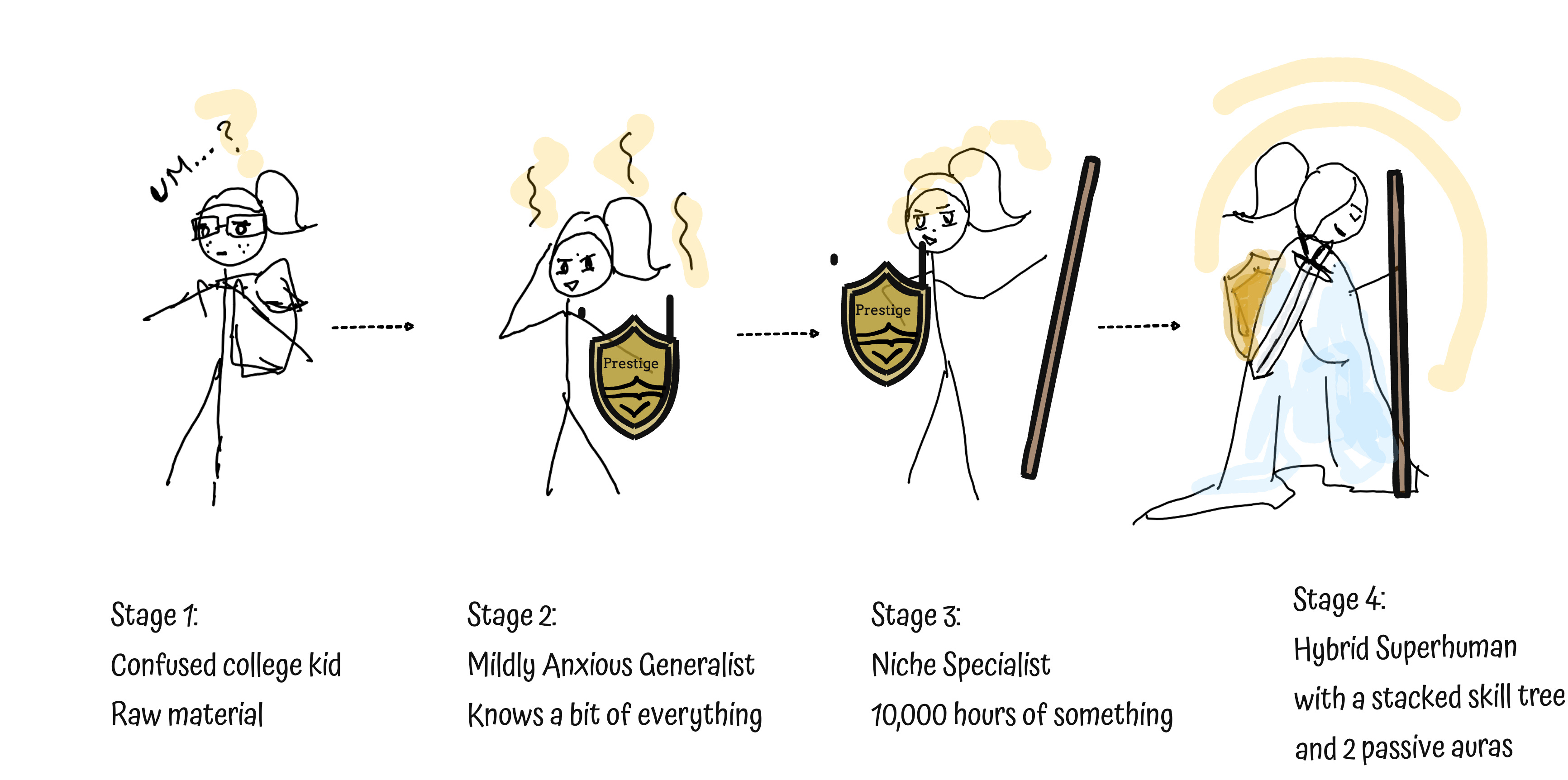
🎮 Dual-Classing is OP (Overpowered)
The real cheat code?
Be a generalist across time, and a specialist in moments.
Learn broadly.
Specialize on demand.
Stack up 2–3 specialist “modes” over a decade.
🎯 This gives you:
The credibility of mastery
The agility of range
The surprise of multiplicity
Think:
Engineer who can sell
Marketer who can code
CEO who started as a theatre kid with mild insomnia and a coffee addiction*
(*Also fun at parties. These side quests open more doors than you’d think.)
You don’t need to pick a side. You need to know your base stats — and then level up with intent.
Be unpigeonhole-able. But also, undeniably good at some sh*t.
Phew. Okay.
Now that we’ve got a perspective — and maybe a few existential XP points — it’s time to chart your path to “victory.”
After all, what’s the point of likening your career to a video game if you’re not planning to beat it?
🎮 Coming Up in Part 2 — this Sunday, 5th October.
Skill tree respecs, career as a series of “bets”, regret monsters, burnout dragons, XP multipliers, and how to escape the wrong dungeon, how to “win” the game, level the playing field with bad “base stats”, and more
Subscribe now to make sure you have this delivered to your inbox!
How do you choose what to specialise in when in level 2?
Very cool just wondering if you used AI to write this? idk if my ai-dar is functioning